
Clearing the air: How real-time smoke data is protecting Australian vineyards
When smoke rolls over a vineyard, the fire isn't the only threat. For Australia's wine industry, some of the biggest costs come afterwards, in the uncertainty that follows. Is the fruit tainted? Should it be picked? Will the buyer still take it?
Until now, answering those questions has meant waiting on lab results that can only be done close to harvest. The Wine Industry Smoke Detector (WISD) changes that, giving growers and winemakers real-time, site-specific smoke data so they can make better, faster decisions when it matters.
The real cost of smoke
Smoke events are expensive, and not always in the ways you'd expect. After the 2019–20 fires, up to 60,000 tonnes of winegrapes went unpicked, and the losses from not harvesting smoke-tainted fruit were much greater than the physical losses from the fires themselves.
Some of that fruit didn't need to be lost at all. Trial data from the 2020 fires found that $100–$150 million worth of grapes were unnecessarily discarded over unfounded concerns about smoke taint.
Part of the problem is timing. Lab testing is costly, the results can be hard to interpret, and grapes are typically only sampled two-to-three weeks before harvest. That leaves growers and winemakers making big calls with very little to go on.
What is a Wine Industry Smoke Detector?
WISDs are in-vineyard sensors that tell growers and winemakers, in real time, whether smoke from a bushfire or planned burn is likely to taint their grapes.
They're built on a decade of research by La Trobe University, supported with funding by Wine Australia. Drawing on more than 2,000 data points collected across more than 70 controlled burns and 10 major bushfires, that work linked smoke measured in the vineyard to outcomes in the wine. According to La Trobe University's Prof Ian Porter, the research “for the first time globally linked the amount of fresh smoke needed in vineyards to smoke taint in the bottle”.
Goanna Ag is the commercial partner, and we now manufacture, supply and support the commercial version, GoWISD.
How GoWISD works
Each unit continuously measures smoke particulates (PM1, PM2.5 and PM10) alongside temperature and humidity, then turns that data into a simple traffic-light risk rating for smoke taint:
Red: taint is almost certain. Make an early decision not to harvest or process.
Amber: taint is possible. Consider analysis or small-batch ferments.
Green: no taint. Manage as normal.
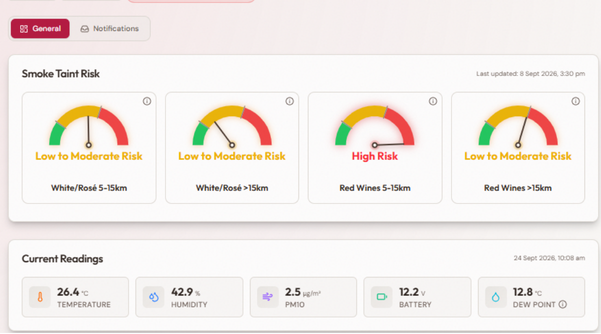
Figure 1: Goanna Ag's GoWISD Dashboard.
Every reading is available in real time through the GoWISD dashboard on desktop or mobile, with your unit shown in its exact location on the map, so you can check smoke conditions in your vineyard wherever you are.
The units are built for the field, with a large solar-charged battery, Cat M1 connectivity with a long-range antenna, an IP66-rated enclosure and a shielded temperature sensor. Each device can be easily mounted on a star picket, and comes with everything needed to self-install and is activated remotely. Once it's in the ground, our team backs every device with remote diagnostics and back-to-base monitoring.
What it means for growers and winemakers
The biggest shift is timing. With GoWISD, you receive a risk rating during the smoke event, rather than waiting on lab results. That means faster, more confident decisions and fewer grapes thrown away. Fruit rated low risk can still be picked, sold and made into wine, protecting both crop value and business confidence.
It also makes testing smarter. Lab work can be focused on the blocks where the data shows genuine risk, instead of testing every block just in case. And when it comes to conversations with grape buyers, wineries and insurers, independent, site-specific data gives everyone objective evidence to work from.
It isn't just a grower tool, either. Winemakers often carry the risk once fruit is bought, so the data is just as useful to wineries. You choose who sees your data, whether that’s consultants, winemakers or grower groups, all while remaining confidential.
And the value doesn't end with the fire season. Dew point monitoring and custom temperature alerts help manage frost risk year-round.
Proven in the field
After the 2019–20 bushfires, a network of 100 prototype devices was deployed in vineyards across north-east Victoria. Since 2022, more than 100 WISD prototypes have been monitoring smoke from bushfires and controlled burns in several states, with the technology refined season after season.
WISD has since received funding from the Australian Government through Australia's Economic Accelerator (AEA) Innovate program to take it to full commercial readiness, and we're now rolling it out across Australian wine regions.
Why interest is growing
With bushfires and planned burns a regular part of the season, growers and winemakers want to get ahead of the risk rather than react to it. Objective, site-specific data also gives them firmer ground in conversations with grape buyers and insurers. And regional grower and wine associations can create networks that give everyone a shared picture during an event.
GoWISD gives growers and winemakers timely, accurate and actionable information, so decisions about harvest, marketing, insurance and winery supply are backed by evidence, not guesswork.
Talk to one of our Agtech experts today about the GoWISD advantage. Contact us
The WISD project is a collaboration between La Trobe University, Wine Australia and Goanna Ag. It is supported by funding from the Australian Government through Australia's Economic Accelerator (AEA) Innovate Program, Wine Australia and La Trobe University.
